
How to Choose Auction or Buy It Now for Sports Cards
An auction needs interested buyers to arrive before the bidding ends. A fixed-price listing lets you set a price and wait for someone willing to pay it. Before choosing between them, check how often the exact card sells and what recent auctions actually achieved.
Start with recent results for the exact card
A famous player can have thousands of different cards. Demand for one rookie, parallel or grade does not automatically carry over to another. Match the year, set, number, parallel and condition first. Our eBay comps walkthrough shows how to search and verify the prices.
Count relevant sales over a consistent period, such as 30 days. That gives you a simple measure of sales velocity: how frequently matching copies sell. Also look at the number of comparable copies currently available. Ten sales with a few competitors presents a different situation from ten sales among hundreds of competing copies.
Then inspect auction results separately. Did several recent auctions attract bidding? Did they finish around the fixed-price sales, or well below them? Bid count is useful context, but four bids do not necessarily mean four different bidders.
A real comparison: one card, several outcomes
We searched raw 2024 Topps Chrome Shohei Ohtani #1 base cards. The public sold view showed these two results on October 13, 2026:
| Format | Item price | Shipping | Total before tax |
|---|---|---|---|
| Auction, one bid | $1.99 | $5.99 | $7.98 |
| Buy It Now | $12.50 | $1.36 | $13.86 |
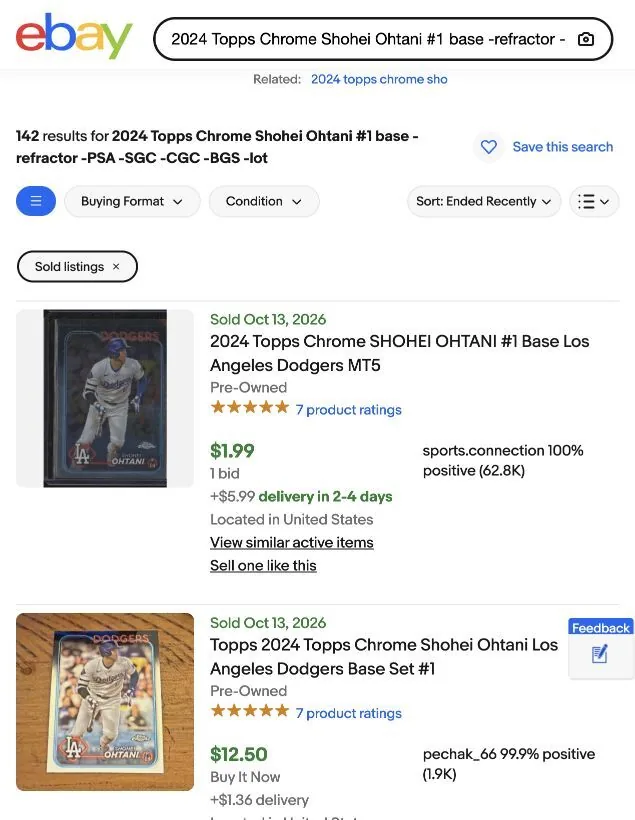
The auction seller’s displayed feedback count was about 62,800. Even a seller with that much feedback can have an auction finish low. The feedback count does not tell us how many followers the seller has or how old the account is.
Product Research provided another comparison: an October 12 auction recorded $7 with four bids, while October 8 and October 1 fixed-price rows recorded $13 and $14.99. Each of those three rows showed one sale and $1.36 shipping.
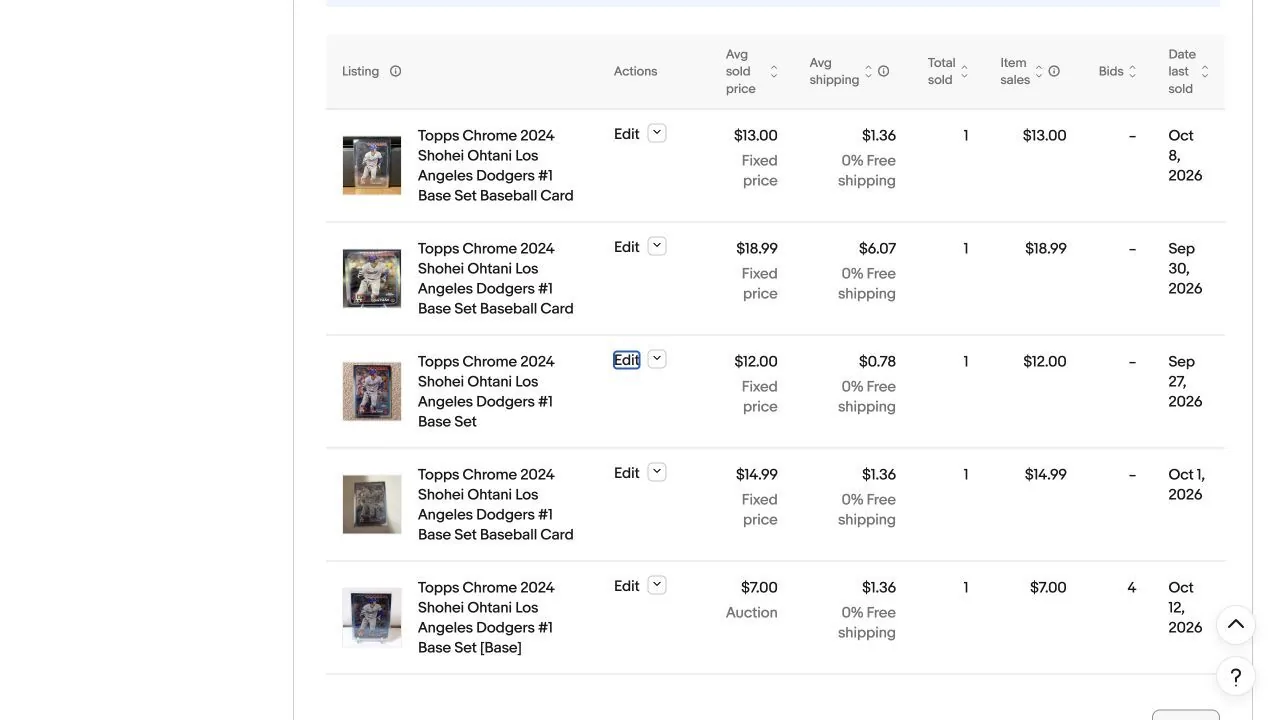
The auctions finished lower in these examples. Format may be part of the reason, but the sellers, dates, photos and card condition also matter. A handful of results is not enough to judge how quickly this Ohtani card usually sells.
When an auction is worth considering
Look for repeated recent sales of the exact version and auctions that attract competitive bids. You want evidence that buyers are actively looking for the card during the period your auction will run. Scarcity may help, but scarcity without interested buyers is not enough.
An auction can also help you find out what buyers are willing to pay, provided you can accept an uncertain result. High sales volume is a helpful signal, not a requirement or a guarantee. A rare card with several motivated buyers can do well even if few copies have sold recently.
Set the starting price deliberately. eBay explains that auctions start at a price you choose and sell to the highest bidder when they end. A low start may attract interest, but it does not create a promise of a higher finish.
When Buy It Now is the more practical choice
Consider fixed price when the card sells infrequently, recent auctions attract little bidding, or you need a particular minimum return. A specialist collector may be willing to pay a reasonable price without happening to search during your auction’s closing window.
Fixed price does not guarantee a sale. You still need realistic comps, clear photos, accurate details and a sensible delivered price. Best Offer can give buyers room to negotiate while you decide which offers meet your requirements.
What if your account is new or your following is small?
Do not assume you will receive the same auction attention as a seller with an established audience. For a new account, a cautious starting approach is fixed price or an auction opening bid that already meets your minimum acceptable sale price.
New accounts can still run successful auctions. These examples do not tell us how much account age or follower count affected the results. Start with prices you can accept, then use your own sales to decide what works.
Choose your minimum before you list
Use the eBay card fee calculator to estimate payout after fees and postage, then account for supplies and card cost. If the minimum outcome would disappoint you, raise the opening bid or choose fixed price.
For your next batch, record the exact card, listing format, price, shipping, sale date and net result. That gives you evidence to improve future choices. For fixed-price drafts, MyCardFlow’s card listing walkthrough takes you from photos through review and publication.
For the full process from identification to minimum price, use our guide to pricing sports cards on eBay.