
How to Price Sports Cards on eBay: From Comps to Asking Price
To price a sports card on eBay, identify the exact version, compare recent sales of similar copies, check competing listings and calculate what you would keep. Then choose an asking price that fits the card’s condition, demand and your willingness to wait.
Keep three numbers separate: what sellers are asking, what buyers have paid, and what remains after your own costs. Confusing them can leave a card overpriced or turn a sale into a loss.
1. Confirm exactly which card you have
Write down the player, year, product, card number, parallel and any serial numbering. Check whether it is a base card, insert, variation, autograph or memorabilia card. A similar-looking card is not automatically a comparable sale.
For graded cards, match both the grading company and grade. For raw cards, compare visible condition as closely as the photos allow. Do not price an ungraded copy as though it has already earned a professional grade.
For example, a raw 2024 Topps Chrome Shohei Ohtani #1 base card belongs in a different comparison group from a Refractor or a PSA 10. Check the card itself before trusting either your search terms or another seller’s title.
2. Build a short list of recent sold comparisons
Search eBay with the identifying details and select Sold Items. Open relevant results and record the sale date, displayed price, shipping charge, quantity and format. Exclude lots, different parallels and You-Pick results whose displayed price belongs to another choice.
Start with several close matches rather than the highest sale you can find. If there are few results, widen the date range. Keep in mind that prices may have changed since an older sale. A single unusual sale is a reason to investigate, not a precise valuation.
For offer-enabled listings, use eBay’s Product Research to check recorded sale prices. Its results can include actual prices when Best Offers were accepted. Inspect the quantity too: a row averaging several sales is not one transaction.
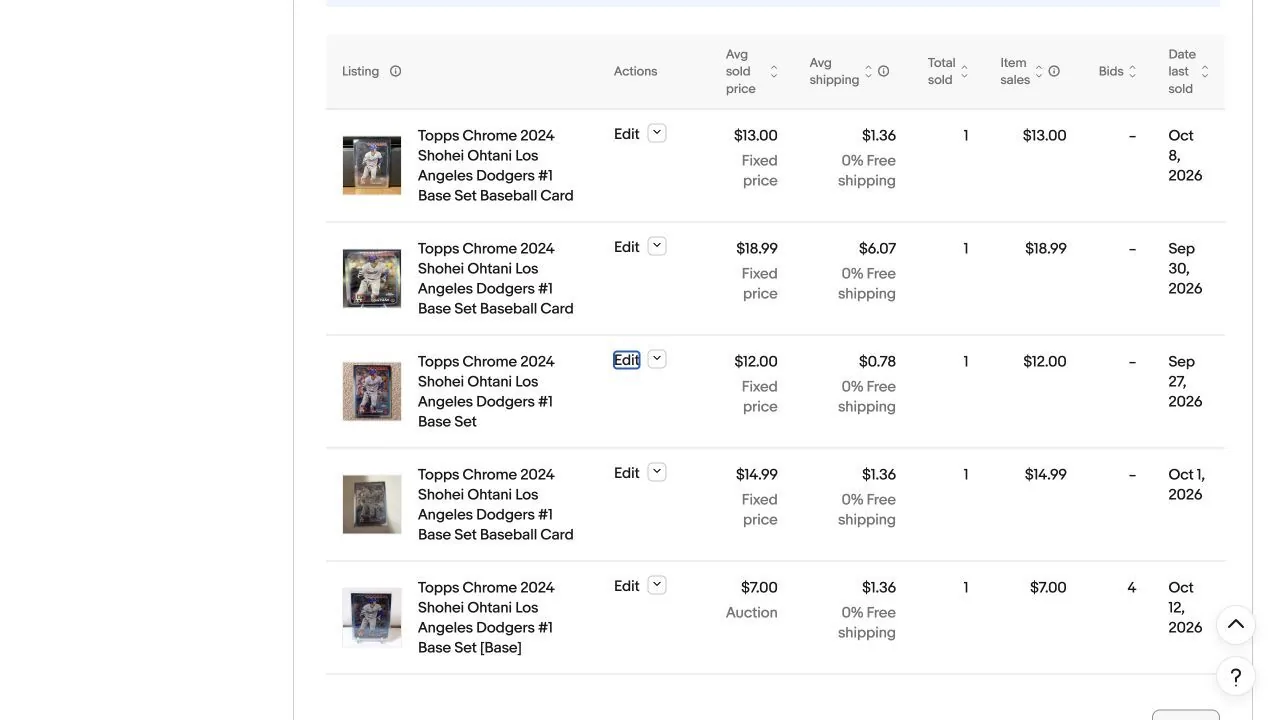
Our screenshot includes fixed-price rows at $13 and $14.99, plus a $7 auction with four bids. The three rows each show one sale and $1.36 shipping. Compare the listings closely, since condition, timing and visibility can affect the price.
3. Check what buyers can purchase today
Active listings show your competition. Compare the total before tax (item price plus shipping) and make sure each result is available as a single matching card. Ignore an unfinished auction’s current bid when estimating completed-sale prices.
A seller can ask an ambitious price indefinitely. That does not make it a comp. The cheapest listing may have damage, a different version or an unexpected delivery charge. Investigate before trying to undercut it.
4. Work out your minimum price
Your asking price is what buyers see. Your minimum is the lowest sale price you are willing to accept after allowing for fees, costs and the profit you want to make.
A useful calculation is:
Item price + buyer-paid shipping − selling fees − postage − supplies − card cost = estimated profit before other overhead and taxes.
Use actual costs and your applicable fees. Buyer-paid shipping is money collected, while postage is an expense; they are not always equal. Include applicable advertising charges and avoid subtracting sales tax as though it were revenue you keep.
| Example costs | Amount |
|---|---|
| Item price | $15.00 |
| Shipping charged to buyer | $1.25 |
| Estimated selling fees (assumed for this example) | $2.60 |
| Postage | $1.25 |
| Supplies | $0.25 |
| Card acquisition cost | $5.00 |
| Estimated profit before other overhead and taxes | $7.15 |
These sample costs show how the calculation works. Use your own postage costs and fee rates. Use the eBay card fee calculator for an estimate with your own selling inputs, then account for acquisition cost, supplies and other expenses separately.
5. Choose a format that fits demand
An auction gives buyers a limited window to compete. Look for repeated matching sales and evidence of bidding activity before choosing a low start. High interest can help, but even a popular player can have a poorly attended auction.
Buy It Now gives you control over the asking price and time to wait for a buyer. It can suit cards with infrequent sales or a minimum return you do not want to gamble on. Best Offer adds negotiation; it does not remove the need for a realistic initial price.
If you choose an auction, make the opening bid an amount you can accept if only one person bids. Do not assume your listing will receive the same attention as a major seller’s auction.
6. Set the asking price and record your reasoning
Choose a price supported by your closest comps, condition and competing delivered prices. Decide whether you are aiming for a quicker sale or are willing to wait. Leave room for offers only if you actually want to negotiate; adding arbitrary padding can make your listing uncompetitive.
Keep a brief note: “Matched raw base sales checked; corner wear disclosed; asking price includes shipping; review after another month.” That note gives you something to refer to when you review the price later.
7. Review slow sellers without automatic price cuts
If a card sits, first check that buyers can identify it from the title, photos and item specifics. Refresh the comps and inspect shipping. Then decide whether the problem is price, presentation or simply a small pool of buyers.
For inexpensive inventory, consider the work per sale too. Our bulk card lot workflow groups cards into one purchase, while You-Pick listings let buyers choose individual cards. Choose the format that makes the cards easier to buy and worth your time to sell.
Frequently asked questions
Should I price my card at the highest sold result?
No. Check why that result differs. Grade, parallel, condition, quantity and timing can all change the comparison. Prefer several close matches over one unusually high result.
Does a high asking price mean my card is worth that much?
No. An asking price tells you what a seller wants. Recent sales of the same card give you a better starting point.
What if there are no close sold comps?
Widen the date range and research the card’s identity again. Related cards can provide context, but avoid treating them as exact matches. A fixed price gives you time to test demand without committing to a low auction start.
Once the research is done, use our sports card listing walkthrough to prepare the card’s photos, details, price and shipping for publication.